Why You Should Sift Your Dry Ingredients Together

Quick Tip
Sift your dry ingredients together to ensure leavening agents are evenly distributed and clumps are eliminated.
Why You Should Sift Your Dry Ingredients Together
A single undetected clump of flour or cocoa powder can ruin the texture of a finished bake, leaving you with an unpleasant, gritty mouthful. Sifting your dry ingredients together is not just an extra step for perfectionists; it is a fundamental technique used to ensure even distribution of leavening agents and to prevent structural failures in your recipes. This post explains exactly how sifting improves your crumb and why skipping this step might be the reason your cakes are inconsistent.
Aeration and Texture
When you sift flour, cocoa powder, or cornstarch, you are introducing air into the particles. This aeration lightens the density of the dry mixture. In recipes like sponge cakes or chiffon cakes, this extra air helps the batter rise more easily and creates a much finer, more delicate crumb. Without this step, heavy clumps of flour can sink to the bottom of your pan, creating dense, gummy layers at the base of your bake. If you have ever dealt with cracking on the top of your cake, it may be due to uneven weight distribution caused by un-aerated dry ingredients.
Even Distribution of Leavening Agents
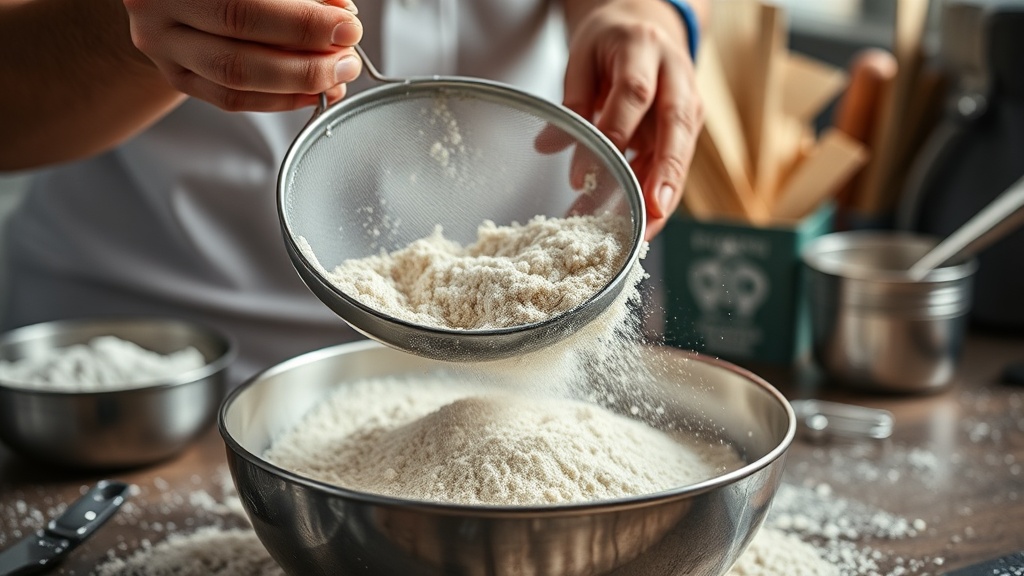
One of the most critical reasons to sift dry ingredients together—rather than just sifting flour alone—is to ensure your leavening agents are perfectly dispersed. Baking powder, baking soda, and salt often come in much finer or more granular forms than flour. If you add these directly to a bowl of flour without sifting, you risk "hot spots." A hot spot occurs when a concentrated pocket of baking soda remains in the batter, resulting in a bitter, soapy taste in one bite and a lack of rise in another. By sifting the flour, cocoa, and leaveners together through a fine-mesh sieve, you guarantee that every gram of your batter has the same lifting power.
Removing Impurities and Clumps
High-fat ingredients, particularly cocoa powder and certain types of starch, are notorious for forming hard clumps during storage. Even a high-quality product can develop lumps due to humidity. Sifting serves as a final quality control check. It allows you to identify and remove any foreign objects or large, unmixable lumps before they enter your wet ingredients. This is especially important when working with high quality cocoa powder, which can be quite dense and prone to clumping.
Quick Sifting Tips
- Use a Fine-Mesh Sieve: A standard metal sieve is more durable and efficient than a handheld sifter for large batches.
- Sift Multiple Times: For extremely light recipes, sift the dry mixture twice to ensure maximum aeration.
- Don't Overcrowd: If you are sifting a large volume, do it in batches. If the sieve gets clogged, the flour won't aerate properly.
- Combine Everything: Always sift your flour, leaveners, and spices together in one motion to ensure a homogenous mixture.