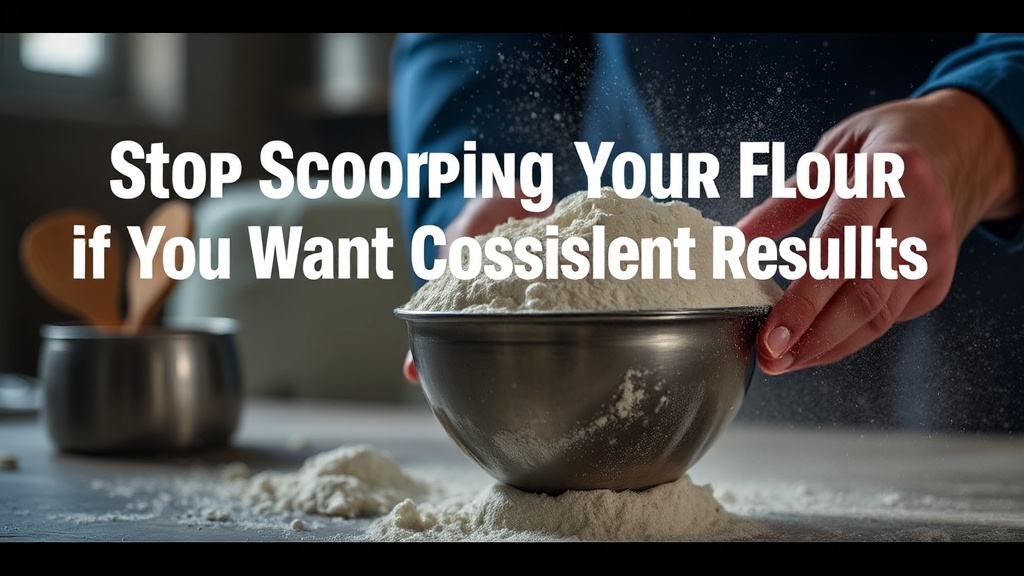
Stop Scooping Your Flour if You Want Consistent Results

You're standing in your kitchen, flour on your apron and optimism in your heart, as you pull a tray of muffins out of the oven. They look fine, but when you bite into one, it's dry, crumbly, and vaguely resembles a desert landscape (and not in a cool, trendy way). You followed the instructions to the letter, used the exact measuring cups the recipe called for, and yet the result is disappointing. This post covers why those plastic measuring cups are secretly ruining your bakes and why switching to a digital scale is the single most effective way to ensure your kitchen wins outweigh your fails. It matters because baking isn't magic—it's math—and your measuring cups are lying to you every single day.
Why does my bread always turn out dry?
The biggest culprit behind dry bread, tough cookies, and dense cakes is almost always the way we measure flour. Think about it: flour is compressible. If you scoop your measuring cup directly into the bag, you're packing those tiny particles together. One person's "cup" might weigh 130 grams, while another's—packed tightly by a heavy hand—could weigh as much as 160 grams. That's a 25 percent difference in the amount of starch you're adding to your bowl. When you have too much flour, the hydration levels of your dough or batter get thrown completely out of whack. The liquid that was supposed to keep your bread soft is instead absorbed by that extra, uninvited flour. The result is a loaf that feels more like a brick than a cloud.
You might have heard the advice to "spoon and level" your flour. This involves gently spooning flour into a cup and then scraping off the excess with a flat edge. While this is certainly better than the direct scoop method, it's still wildly inconsistent. Humidity, the age of the flour, and even how much you've shaken the bag can change how much flour fits into that little plastic vessel. Professional bakers don't look at volumes for this very reason. They look at mass. Mass doesn't change based on how you feel that morning or how much air is trapped between the grains. If a recipe calls for 500 grams of flour, 500 grams is always 500 grams. This level of precision is what takes the guesswork out of the equation and makes the whole process feel much less scary for those of us who didn't grow up in a bakery.
Is a kitchen scale worth the counter space?
Many home bakers hesitate to buy a scale because they think it's an unnecessary gadget that will just gather dust next to the spiralizer. In reality, a scale is one of the few tools that actually makes your life easier and your kitchen cleaner. Think about the mountain of dishes you create when making a standard cake. You have a cup for flour, a half-cup for sugar, a quarter-cup for cocoa, and a series of teaspoons for leavening agents. Every single one of those needs to be washed, dried, and put away. When you use a scale, you can place your mixing bowl directly on the platform, hit the "tare" button to zero it out, and pour in your ingredients one by one. You aren't just getting better results; you're doing eighty percent fewer dishes (and believe me, that's the real victory here).
Speed is another factor that often gets overlooked. Once you get used to the rhythm of pouring until the numbers hit your target, you'll find that prepping a recipe takes half the time. There's no more digging around in drawers for the 1/3 cup measure that always seems to go missing. You also gain the ability to scale recipes up or down with zero effort. If you want to make a batch and a half of cookies, trying to calculate "half of three-quarters of a cup" is a recipe for a headache. If you're working in grams, you just multiply the number by 1.5. It's clean, simple, and far less prone to the kind of math errors that lead to flat, sad cookies. Authoritative sources like