Mastering Sourdough: A Beginner's Guide to Your First Perfect Loaf

Sourdough bread has a reputation for being finicky and intimidating. This guide breaks down the entire process—from starter maintenance to that satisfying ear on your finished loaf—so anyone with a kitchen and some patience can produce bakery-quality bread at home. You'll learn the timing, the techniques, and the small details that separate dense bricks from airy, flavorful boules.
What Do You Actually Need to Start Baking Sourdough?
A scale, a Dutch oven, and a mature starter. That's it. Everything else is optional (though helpful).
The sourdough community loves gear. Bannetons, lame knives, proofing boxes, hydration calculators—there's no shortage of toys. Here's the thing: people baked excellent bread for thousands of years with far less. Start simple. Add tools as skills develop.
| Tool | Purpose | Budget Alternative |
|---|---|---|
| Kitchen scale | Accurate measurements | Escali Primo Digital Scale ($25) |
| Dutch oven | Traps steam for oven spring | Lodge 6-Quart Enameled ($80) |
| Banneton | Shapes and proofs dough | Mixing bowl + floured towel |
| Bread lame | Clean scoring | Sharp razor blade |
| Bench scraper | Handling sticky dough | Plastic dough scraper ($3) |
The scale matters most. Volume measurements (cups, tablespoons) vary wildly depending on how flour settles or gets packed. Grams don't lie. A King Arthur Baking sourdough starter needs consistency to thrive—50 grams of flour means 50 grams, not "about half a cup."
How Do You Feed and Maintain a Sourdough Starter?
Discard half, add equal parts flour and water by weight, and wait 4-12 hours until bubbly and doubled.
That said, there's nuance here. Starters are living cultures—wild yeast and bacteria that need food, warmth, and time. Most beginners kill starters through neglect (too cold, no food) or overfeeding (too much flour, not enough time to digest).
The classic ratio: 1:1:1. One part starter, one part flour, one part water. A 50-gram feeding uses 50g starter + 50g flour + 50g water. This keeps things manageable and predictable.
Worth noting: temperature controls everything. At 75°F (24°C), a starter might peak in 4 hours. At 65°F (18°C), the same feeding takes 8-10 hours. Many home bakers use the oven with the light on—a steady 75-78°F that keeps yeast happy without cooking anything.
The discard question comes up constantly. Yes, you throw away half at each feeding. (Or make discard recipes—pancakes, crackers, banana bread.) The alternative is ending up with a gallon of bubbling goo that demands a bag of flour daily.
Recognizing a Healthy Starter
Look for these signs:
- Doubles in size within 4-8 hours of feeding
- Bubbly, foamy texture throughout—not just on top
- Pleasant sour smell (like yogurt or vinegar), not nail polish remover (that's acetone, meaning it's hungry)
- Falls back down after peaking (called "falling" or "collapsing")
A new starter takes 7-14 days to mature. Be patient. The first few days might look dead—no bubbles, no rise. Keep feeding. By day five or six, activity should spike as the wild yeast population establishes itself.
Why Does Sourdough Timing Feel So Tricky?
Because it is. Sourdough doesn't follow a clock—it follows fermentation stages.
Commercial yeast breads offer predictability: mix, rise 60 minutes, shape, rise 30 minutes, bake. Sourdough operates on biological time. The same recipe might take 6 hours in summer and 12 hours in winter. The catch? Learning to read the dough, not the clock.
Bulk fermentation—after mixing but before shaping—is where flavor develops. The dough should grow 50-75% in size, not double. (Doubling means you've gone too far.) Look for bubbles on the sides, a jiggly texture, and that slightly domed surface.
The poke test reveals readiness. Wet a finger, poke the dough:
- Underproofed: Dough springs back immediately—needs more time
- Perfect: Indent springs back slowly, partially—ready to shape
- Overproofed: Indent stays—bake anyway, but expect less oven spring
Here's the thing most recipes don't emphasize: cold proofing. After shaping, refrigerate the dough 12-48 hours. This develops deeper sour flavor, firms the dough for easier scoring, and—most importantly—lets you bake on your schedule. No more 3 AM baking because the dough decided it was ready.
What's the Best Flour for Beginner Sourdough?
Bread flour—12-14% protein content—offers the most forgiving starting point.
All-purpose works. Whole wheat works. Rye works. But bread flour (King Arthur Baking Bread Flour, Bob's Red Mill Artisan Bread Flour) hits the sweet spot: enough gluten to trap those precious gas bubbles, but not so much protein that shaping becomes a wrestling match.
Whole grains add flavor and nutrition. They also add difficulty. Whole wheat ferments faster (more minerals for yeast to snack on), absorbs more water, and creates denser crumb. Start with 10-20% whole wheat, see how it behaves, then increase gradually.
That said, don't obsess over organic or specialty flours at first. A consistent, affordable bread flour from the grocery store beats inconsistent fancy flour. Once the basics feel solid—then experiment with heirloom grains, fresh-milled wheats, or Central Milling's Type 00.
Hydration: What Percentage Should Beginners Target?
Start at 70-75% hydration. That means water weight is 70-75% of flour weight.
High hydration (80%+) creates those Instagram-famous open crumbs with giant holes. It also creates sticky, shapeless nightmares for beginners. Lower hydration (65-70%) yields tighter crumb but easier handling—and honestly, tastes just as good.
| Hydration Level | Water:Flour Ratio | Best For |
|---|---|---|
| 65-68% | 650-680g water per 1000g flour | Sandwich bread, beginners |
| 70-75% | 700-750g water per 1000g flour | Everyday sourdough boules |
| 78-82% | 780-820g water per 1000g flour | Open crumb, experienced bakers |
| 85%+ | 850g+ water per 1000g flour | Ciabatta, advanced techniques |
Your flour's absorption matters too. King Arthur Bread Flour handles 75% hydration beautifully. Some grocery store brands need 70% to feel the same. Adjust based on feel, not just numbers.
How Do You Actually Shape Sourdough?
Create surface tension. Everything else—folding, pre-shaping, final shaping—serves that single goal.
After bulk fermentation, turn the dough onto a lightly floured surface. Divide if making two loaves. Pre-shape into loose rounds, rest 20-30 minutes (bench rest), then final shape.
The envelope fold works for most beginners:
- Gently stretch the dough into a rough rectangle
- Fold the bottom third up, like a letter
- Fold the top third down
- Fold the left side in, then the right
- Roll from the top down, tucking and sealing as you go
- Drag the loaf toward you, seam-side down, to tighten the skin
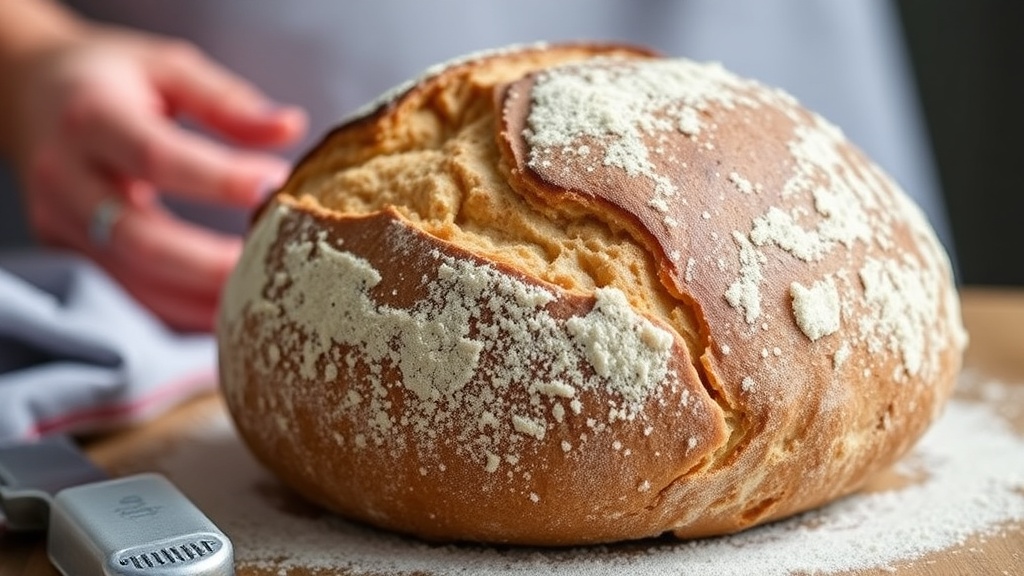
Surface tension—that tight "skin" on top—traps gases during oven spring. Weak tension means flat, spread-out loaves. Strong tension means tall, proud boules with that dramatic ear where the score opened.
Place seam-side up in a floured banneton (or towel-lined bowl). The fridge awaits.
What About Baking and Scoring?
Preheat the Dutch oven to 500°F (260°C) for at least 45 minutes. Cold pots murder oven spring.
Transfer the cold dough onto parchment, score quickly with confidence (a single deep slash beats five timid scratches), and drop into the screaming hot pot. Lid on. 20 minutes.
The steam trapped inside keeps the crust soft, allowing the loaf to expand—called "oven spring." After 20 minutes, remove the lid, drop to 450°F (232°C), and finish baking 20-25 minutes until deeply golden.
Scoring isn't decoration. It's functional. A proper score guides where the loaf expands. No score means random blowouts. A too-shallow score seals back up. Aim 1/4 to 1/2 inch deep at a 45-degree angle—this creates the "ear" that lifts and curls.
Cool completely before slicing. (Really. Two hours minimum.) Hot bread continues cooking inside; cutting early gummifies the crumb and releases steam that should have reabsorbed.
Troubleshooting Common Problems
Dense, gummy interior: Underproofed. Let bulk fermentation go longer next time.
Flat, spread-out shape: Weak shaping or overproofed. Build more tension, watch timing closer.
No oven spring: Oven not hot enough, pot not preheated, or dough overproofed.
Bitter, overly sour taste: Proofed too long or too cold. Fermentation produces acetic acid (sharp, vinegar-like) when cold; lactic acid (mild, yogurt-like) when warm.
"The best sourdough bread is the one you actually bake. Perfection comes from repetition, not from waiting until conditions are ideal."
Start this weekend. Mix flour and water. Build that starter. In a week—maybe two—you'll pull a crackling, golden loaf from your oven that you made from nothing but flour, water, salt, and time. The first loaf might be uneven. The fifth will be recognizable. The twentieth? That's when neighbors start asking if you sell bread.