How to Temper Chocolate for a Shiny Finish

The Truth About Chocolate Tempering
Many bakers believe that tempering chocolate is a high-level professional skill reserved for pastry chefs in Michelin-starred kitchens. The common misconception is that you need expensive machinery or a specialized laboratory environment to achieve a glossy, snap-worthy finish. In reality, tempering is simply a controlled process of melting and cooling chocolate to manipulate the crystallization of cocoa butter. When you master this, your homemade truffles, dipped pretzels, and chocolate bars will look professional rather than dull and streaky. This guide provides the exact steps and temperatures required to temper chocolate successfully in a standard home kitchen.
Without proper tempering, chocolate often suffers from "bloom." This is that unappetizing white, dusty coating that appears on the surface. Bloom isn't mold; it is simply cocoa butter separating from the solids and rising to the top because the crystals weren't stabilized correctly. By following the specific temperature stages outlined below, you ensure the chocolate has a stable crystalline structure, resulting in a firm snap and a high-gloss shine.
Understanding the Science of Cocoa Butter
To temper effectively, you must understand what is happening inside the chocolate. Chocolate contains cocoa butter, which is a fat that can crystallize in several different ways. There are six types of chocolate crystals, but only one—Type V (Beta crystals)—provides the shiny finish and firm texture we want for confectionery. Tempering is the process of encouraging these Type V crystals to form while eliminating the unstable, lower-melting-point crystals.
There are two main types of chocolate you will encounter: dark, milk, and white. It is crucial to note that white and milk chocolates have much lower melting points because of the higher milk fat content. If you use a temperature guide for dark chocolate on white chocolate, you will likely scorch the product. Always check the specific temperature requirements for the variety you are using.
Essential Tools for Success
Before you begin, gather these specific tools to ensure accuracy. Precision is the difference between a successful batch and a wasted bag of high-quality chocolate.
- Digital Instant-Read Thermometer: A standard analog thermometer is often not sensitive enough. Use a digital probe thermometer to track temperature changes to within 0.1 degrees.
- Microwave-Safe Bowl: Glass or heavy-duty ceramic works best for even heat distribution.
- Silicone Spatula: This allows you to scrape the sides of the bowl to ensure no un-melted chunks remain.
- Double Boiler or Heat-Proof Bowl: If using a stovetop method, you will need a bowl that sits securely over a saucepan.
- Parchment Paper: For testing the chocolate's set.
The Seeding Method: A Step-by-Step Guide
The seeding method is the most reliable technique for home bakers. It involves melting a portion of your chocolate and then adding "seed" chocolate (unmelted, finely chopped pieces) to lower the temperature and introduce stable crystals.
Step 1: Prepare Your Chocolate
Finely chop your chocolate using a sharp chef's knife. Do not use chocolate chips straight from the bag if possible; most commercial chocolate chips contain stabilizers that make them difficult to melt smoothly. Instead, use high-quality baking bars like Guittard or Callebaut. Chop the chocolate into uniform, small pieces to ensure even melting.
Step 2: The Melting Phase
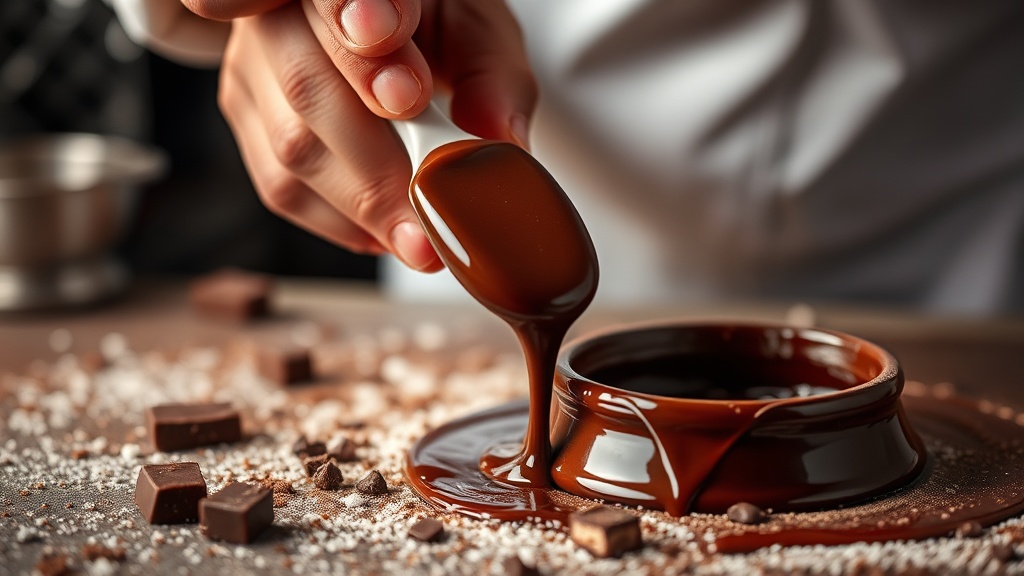
There are two ways to melt your chocolate. You can use a microwave in 20-second intervals, stirring thoroughly between each burst, or use a double boiler. If using a double boiler, ensure the bottom of your bowl does not touch the simmering water. If even a single drop of water enters your chocolate, it will "seize," turning the chocolate into a grainy, unworkable paste. Heat the chocolate until it reaches the target temperature for its type. For dark chocolate, this is typically between 115°F and 120°F (46°C–49°C).
Step 3: The Seeding Phase
Once the chocolate is fully melted and smooth, remove it from the heat source. Add about one-third of your reserved, finely chopped chocolate (the "seed") to the melted liquid. Stir constantly with your silicone spatula. The un-melted chocolate will act as a cooling agent and provide the necessary crystals to the liquid. Continue adding the remaining chocolate in small increments until all the pieces have melted and the temperature has dropped to the "working" range.
Step 4: The Working Temperature
This is the most critical stage. You must bring the chocolate to its specific working temperature. For dark chocolate, the target is usually 88°F–91°F (31°C–32°C). For milk chocolate, aim for 86°F–88°F (30°C–31°C), and for white chocolate, aim for 82°F–84°F (31°C–32°C). If the temperature is too high, the chocolate will be too thin and won't set properly. If it is too low, it will become thick and difficult to dip.
Step 5: The Test
Before you start dipping or pouring, perform a test. Dip a piece of parchment paper or a metal spoon into the chocolate and set it on the counter. Within two to three minutes, the chocolate should set firmly and look matte/shiny rather than greasy. If it stays soft or looks oily, it is not properly tempered. You will need to restart the process by gently reheating the chocolate to the melting stage and starting over.
Common Troubleshooting and Mistakes
Even with a thermometer, things can go wrong. Here are the most frequent issues home bakers face:
The Chocolate Seized: This is usually caused by moisture. If you see the chocolate turn from a smooth liquid to a thick, clumpy mess, water has entered the bowl. Unfortunately, once chocolate has seized, it cannot be un-seized for dipping or coating. However, you can often save it for use in brownies or a ganache by adding more fat (like vegetable oil or melted butter), though it will no longer be suitable for tempering.
The Chocolate is Too Thick: If your working chocolate feels sluggish, you may have dropped the temperature too low. You can gently warm the bowl over a warm (not hot) water bath to bring it back up to the working range, but be careful not to overshoot the target temperature.
The Chocolate is Grainy: This is often a sign of overheating. If you heat the chocolate above 130°F (54°C) for dark chocolate, you can damage the proteins and the sugar, resulting in a gritty texture. Always monitor your thermometer closely.
Practical Applications for Your Tempered Chocolate
Once you have successfully tempered your chocolate, the possibilities are endless. Use your skills for these specific projects:
- Chocolate Bark: Pour a thin layer of tempered dark chocolate onto parchment paper, sprinkle with sea salt or crushed nuts, and let it set.
- Dipped Fruit: Dip fresh strawberries or dried apricots into your tempered chocolate for a professional-looking gift.
- Chocolate Shells: Use a silicone mold to create hollow chocolate spheres or shells for cake decorating.
- Homemade Truffles: Use your tempered chocolate to coat ganache centers, ensuring a crisp shell that holds the soft center.
Remember, the key to successful baking—and tempering—is patience and precision. If your chocolate isn't behaving, don't be afraid to start over. Every "fail" is just a step toward a better finish next time. Happy baking!
Steps
- 1
Chop the chocolate into small, even pieces
- 2
Melt two-thirds of the chocolate in a double boiler
- 3
Add the remaining chocolate to seed the mixture
- 4
Stir constantly until the temperature reaches the target range