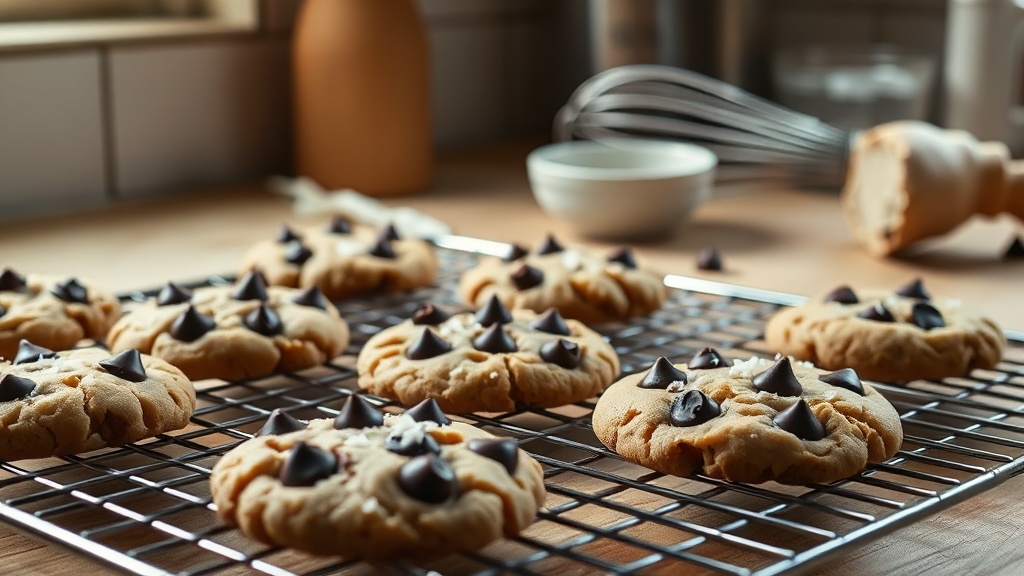
Brown Butter Miso Cookies: The Sweet-Savory Cookie That Broke My Brain

I have a cookie problem. Not the eating-too-many kind (well, also that). The other kind — where I can't stop messing with a recipe until I understand why it works.
This particular obsession started about three months ago when I was stress-eating a bag of chocolate chip cookies and thought: why do store-bought cookies taste like they're missing something? They're sweet. Buttery. Fine. But there's a ceiling. You get one note — sweetness — and then it just... stops. There's no depth, no finish, no "wait, what was that?"
I've been chasing that "wait, what was that?" my whole baking life.
The Problem Nobody Actually Talks About
Here's my experience of sweetness in baking: it feels one-dimensional. You can add more of it (more sugar, more chocolate chips, more caramel swirl), but you can't add depth with more sweetness. At some point, more sweet just means more cloying.
Salt helps — we all know that. The famous "pinch of salt" advice exists because salt suppresses bitterness and allows sweet flavors to come forward. But salt alone isn't enough. It's adjusting the volume, not the frequency.
What I wanted was something that would make a cookie taste complex. Something that tricked the palate into finding layers.
I found it in my fridge. Specifically, the back corner where I keep the miso paste I use for Popo's glazes.
Why Miso, of All Things
Let me back up. My grandmother made everything from scratch — char siu bao, egg tarts, pineapple buns. Growing up, I thought this was normal. In college I realized it was actually exceptional. But what I didn't realize until embarrassingly recently was that Popo wasn't just adding ingredients. She was building flavor architecture.
Her char siu filling has this depth that store-bought versions can't touch. The pork is sweet, yes — but it also has this savory undertone that makes you want another bite before you've finished the first one. I always assumed it was the marinade. Technique. Years of practice.
A lot of it is the umami. Specifically, it's fermented soybean paste working in the background, deepening what's already there.
Here's the food science part: miso paste contains high levels of free glutamate, an amino acid that accumulates during fermentation as proteins in soybeans break down. Glutamate activates umami receptors on your tongue, which interact with other taste signals in complex ways. Umami doesn't taste "savory" exactly — in my experience, it tastes like more. It extends flavors and rounds sharp edges.
Research on how umami interacts with sweetness is genuinely interesting (and still being actively studied). What the literature suggests is that the relationship is context-dependent — umami doesn't simply lower your sweetness threshold, but it can make overall flavor perception feel richer and more complete, which in practice means you feel satisfied at a lower sweetness level. I can't make that a hard rule, but I can tell you what I tasted across 50+ batches: cookies with miso felt more complex and more satisfying than cookies without it, at the same sugar level.
That tracks with something I think gets overlooked in the "salted caramel is popular because of salt" explanation. Salt and umami together may both be contributing to that satisfaction signal — sweet-plus-complexity landing differently than sweet alone. That's my working theory, anyway. Not peer-reviewed.
Testing Three Miso Types (Or: 50 Batches I Don't Regret)
I'm not going to pretend this was a casual experiment. I tested white miso, red miso, and black miso across multiple batches with controlled variables: same brown butter base, same sugar ratios, same chocolate percentage, same bake time. I tasted every single one with and without chocolate. I made my partner eat cookies for two straight months. (He did not complain.)
Here's what I found:
White miso (shiro miso): The one. White miso is the most lightly fermented — it's younger, milder, and sweeter-tasting on its own. In cookies, it adds a subtle savory depth that you can't quite name. My sweet spot: 2 teaspoons dissolved in the brown butter. At 1.5 tsp, too subtle — interesting but not memorable. At 2 tsp, you get the "wait, what is that?" moment without the "oh, this tastes like miso paste" moment. (I tried 2.5 tsp. That batch tasted like someone had opinions about soup. Moving on.)
Red miso (aka miso): Bolder, longer fermented, much more assertive. At 1 tsp it was almost good — there was a nice earthy note. At 1.5 tsp (the max I'd use), it started tasting like I had baked a mistake. The batch I made at 2 tsp I will not describe further. The lesson: red miso has its place in baking (I've used it in glazes and marinades), but it overwhelms cookie dough. The fermented funk that makes it great in ramen broth is too much against buttery sugar.
Black miso (hatcho miso): Skip it. Hatcho miso is aged for at least a year — many producers cite closer to two — and has an almost molasses-like intensity. I tried it twice and both times the cookies tasted like they were angry. Not going back.
The Recipe That Actually Works
This is a standard chocolate chip cookie foundation, modified for the miso technique.
Ingredients
- 2¼ cups (285g) all-purpose flour
- 1 tsp baking soda
- ½ tsp fine sea salt
- 1 cup (227g) unsalted butter
- 2 tsp white miso paste
- ¾ cup (150g) granulated sugar
- ¾ cup (165g) packed brown sugar
- 2 large eggs, room temperature
- 2 tsp vanilla extract
- 1½ cups (255g) dark chocolate chips or chopped dark chocolate (70%+ cocoa)
Method
Brown your butter properly. Medium heat, light-colored pan so you can see the color change. Stir constantly. You want deep amber and nutty-smelling — not golden, not dark brown. Pour immediately into a large bowl and let it cool to room temperature. (This step matters. Hot brown butter partially cooks your eggs and ruins your texture. Patience.)
If you're unsure about butter temperature and texture, read about what room temperature butter actually means — it makes a real difference.
Dissolve the miso. Whisk the 2 tsp white miso directly into the cooled brown butter until fully incorporated. No lumps. This is how the miso integrates evenly — if you add it to the dough later, you get pockets.
Whisk in sugars. Add both sugars to the miso butter and whisk until combined. It should look like wet sand.
Add eggs and vanilla. Whisk vigorously for about a minute. You want the mixture to lighten slightly — this builds structure.
Fold in dry ingredients. Add flour, baking soda, and salt. Stir until just combined. Overmixing = tough cookies. A few flour streaks are fine at this point. (Check out common baking mistakes if you're still working out your mixing technique.)
Fold in chocolate. Now mix until no flour streaks remain.
Chill the dough. At least 1 hour, up to 48 hours. (In my testing, 48-hour dough had noticeably better flavor — the brown butter and miso seemed to integrate more fully. I ran the side-by-side comparison, and I'd do it again. Your call.)
Bake at 375°F (190°C) for 10–12 minutes, until edges are set and centers look slightly underdone. They continue cooking on the pan. Pull them when they're not quite ready.
Yield: About 24 cookies
A note on chocolate: Use dark 70%+ or skip it entirely. Miso + white chocolate is a flavor disaster — the sweetness of white chocolate competes with the miso's umami notes and you get something confused and slightly funky. Milk chocolate is better than white chocolate but still muddies the savory undertone. Dark chocolate's slight bitterness works with the miso complexity instead of against it.
What This Taught Me About Flavor Architecture
The bigger thing I took away from 50+ batches isn't the recipe. It's the framework.
When Popo made char siu bao, she wasn't cooking by feel alone. She was (without calling it this) engineering flavor layers: sweet on top, savory underneath, umami doing the work in the background so the whole thing tasted richer than the sum of its parts.
I always learned from her by watching and tasting. I absorbed the results without understanding the mechanism. This cookie is the first time I consciously understood what she was doing.
The way I think about it now — and this is a useful personal framework, not a law of baking physics — is that every sweet baked good has a satisfaction ceiling. You can push past that ceiling not by adding more sweetness, but by layering in umami compounds that give your palate something else to hold onto. Miso is one tool. Parmesan is another (yes, in cookies — I'm working on it). Brown butter itself contributes, too: what gives it that nutty, complex flavor is the Maillard reaction browning the milk solids, while the butterfat caramelizes and the water cooks off. It's not just browned milk solids — it's that whole reaction happening together, and it's the reason brown butter adds so much more flavor than melted butter.
Layering textures and flavors together is one of the most interesting trends in 2026 baking — it's what designers and home bakers both realize: contrast matters more than single-note excellence.
The testing approach I use now: when I want to add depth to something sweet, I think about the finish — not the first bite, but the aftertaste. In my experience, if the finish is clean and blank, umami is usually what's missing. If the finish is sharp or acidic, fat or salt helps. If it's heavy and one-note, I try acid. Miso cookies, to me, have this warm, lingering savory finish that makes you reach for the next one before you realize you're doing it.
The Honest Fail Worth Mentioning
Batch 23 is burned into my memory: I thought if 2 tsp white miso was good, 2 tsp white miso + 1 tsp red miso would be better. Depth + complexity, right?
Wrong. The batch tasted like I was trying to prove something. Too assertive, too present. The miso stopped working in the background and started announcing itself. Which is the whole point of the white miso choice — it should make your cookie taste more like itself, not like miso paste baked into a cookie.
The lesson I keep coming back to: subtlety is the technique. The goal isn't to taste the miso. The goal is to taste the cookie and not understand why you've eaten five.
Try this recipe. Pay attention to the finish. And the next time you're baking something sweet and it feels like it's missing a layer you can't quite name — start thinking about what's working in the background.
Popo figured it out decades ago. We're just catching up.
Happy baking, happy experimenting.
— Emma